Publications
"What we observe is not nature itself, but nature exposed to our method of questioning"
- Werner Heisenberg
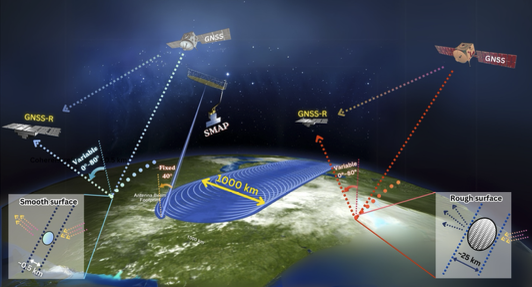
Beyond SMAP: Can GNSS-R platforms ensure continuity of global1 soil moisture observations?
Water Resources Research
SMAP, the world's benchmark soil moisture satellite, is long past its design life with no replacement planned, and the cheaper GNSS-R technique is being pitched as its successor. This paper argues it cannot be: GNSS-R samples irregularly, covers less ground, and falters under GPS jamming and dense vegetation -- and its low cost is partly illusory, since its best products are calibrated on SMAP itself. GNSS-R complements SMAP rather than replacing it, so both need funding to keep the record unbroken.
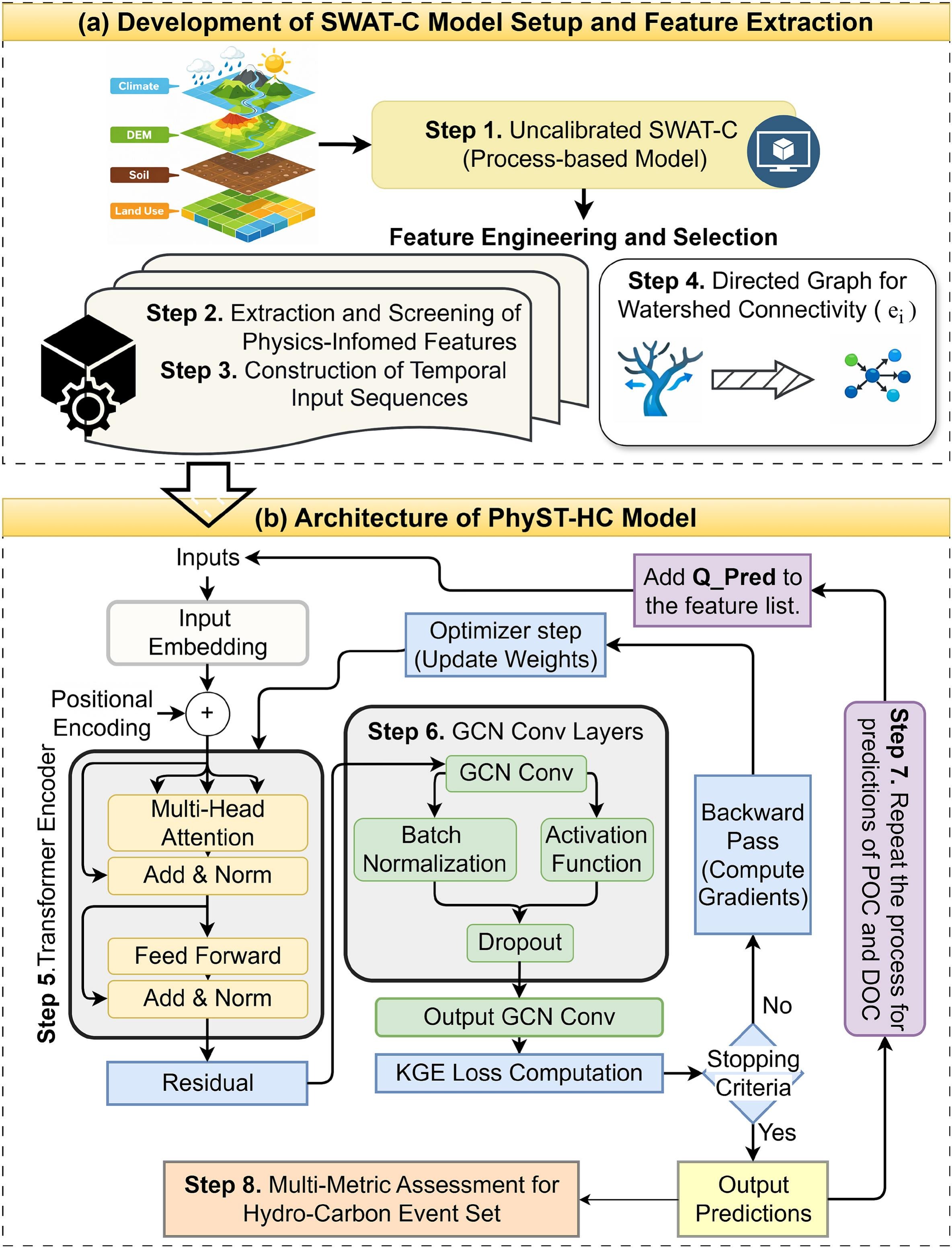
Hierarchical prediction of streamflow and organic carbon at event scale using a physics-guided AI hybrid framework
Journal of Hydrology
PhyST-HC combines an uncalibrated SWAT-C model with graph neural networks and a Transformer to predict storm-driven streamflow and organic carbon in an agricultural watershed, matching calibrated model performance for flow (KGE = 0.82) and beating it clearly for particulate and dissolved carbon (KGE = 0.68 and 0.74) — with no site-specific calibration.
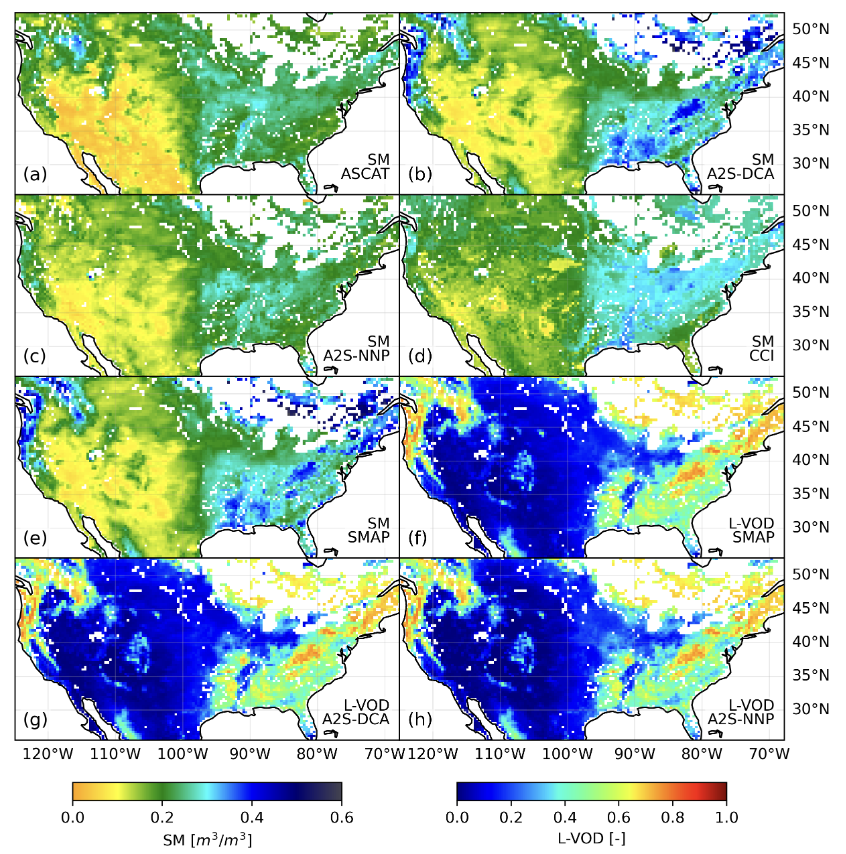
ASCAT2SMAP-V2: Deriving L-band-like Soil Moisture and Vegetation Optical Depth from C-band Satellite Observations
IEEE Journal of Selected Topics in Applied Earth Observations and Remote Sensing
L-band satellites give the best soil moisture and vegetation water estimates, but they only exist from 2010 onward — so we converted older ASCAT scatterometer data into L-band-like soil moisture, used it to simulate L-band brightness temperatures, and retrieved soil moisture and vegetation optical depth from those; the results match SMAP and ground measurements, and an updated τ-ω parameterization further cuts bias over vegetation, showing this approach can extend L-band-like records back before L-band satellites existed.
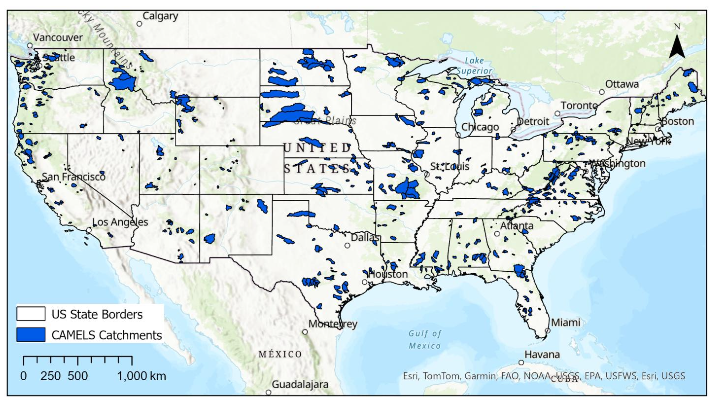
Deep Learning Approaches for Streamflow Flash Drought Prediction Across the Contiguous United States
Journal of Hydrology
This study evaluates whether deep learning models can improve the prediction of streamflow flash droughts. Three models were compared using data from 671 catchments across the United States. The Transformer-based model consistently achieved the highest prediction accuracy and flash drought detection, demonstrating its potential for drought early warning and water resources management.
Dynamics of groundwater-land surface response times as a dryland flash drought diagnosis
Communications Earth & Environment (Nature Portfolio)
How fast does a drought sink into the ground?
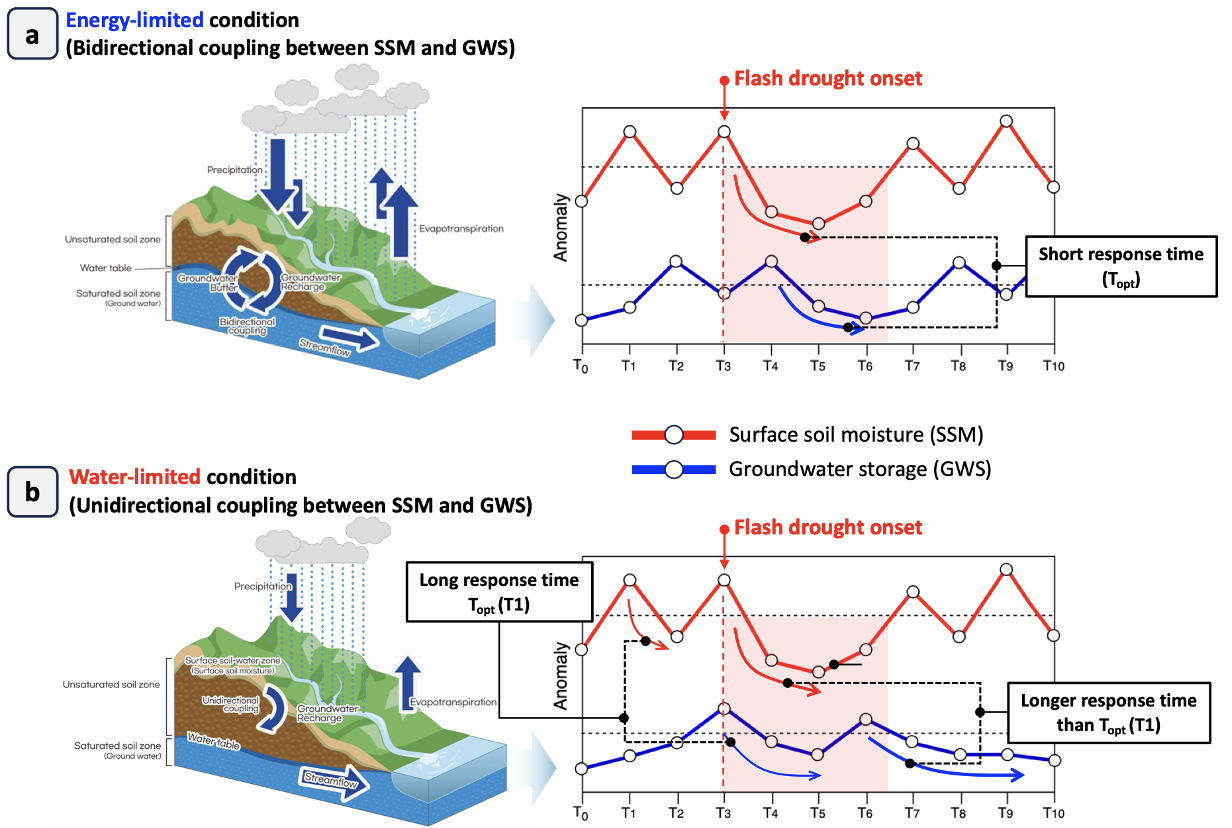
Flash droughts can dry out a green landscape in weeks, and catching them early is hard. Our new study examines an overlooked underground clue: how quickly moisture anomalies at the surface travel down to groundwater, a measure we call the groundwater-land surface response time. Mapping it globally with a dynamic exponential filter, we found that in drylands this response time is long and flash droughts are frequent, because a combined evapotranspiration and runoff deficit stretches the response out and weakens its link to drought behavior. But in wetter seasons the response time reacts quickly and in both directions with flash drought onset and timing, making it a promising early warning signal precisely when early action matters most.
Enhancing Detection of Inundated Areas using Novel Hybrid PolSAR-Metaheuristic-Deep Learning Models
IEEE Journal of Selected Topics in Applied Earth Observations and Remote Sensing
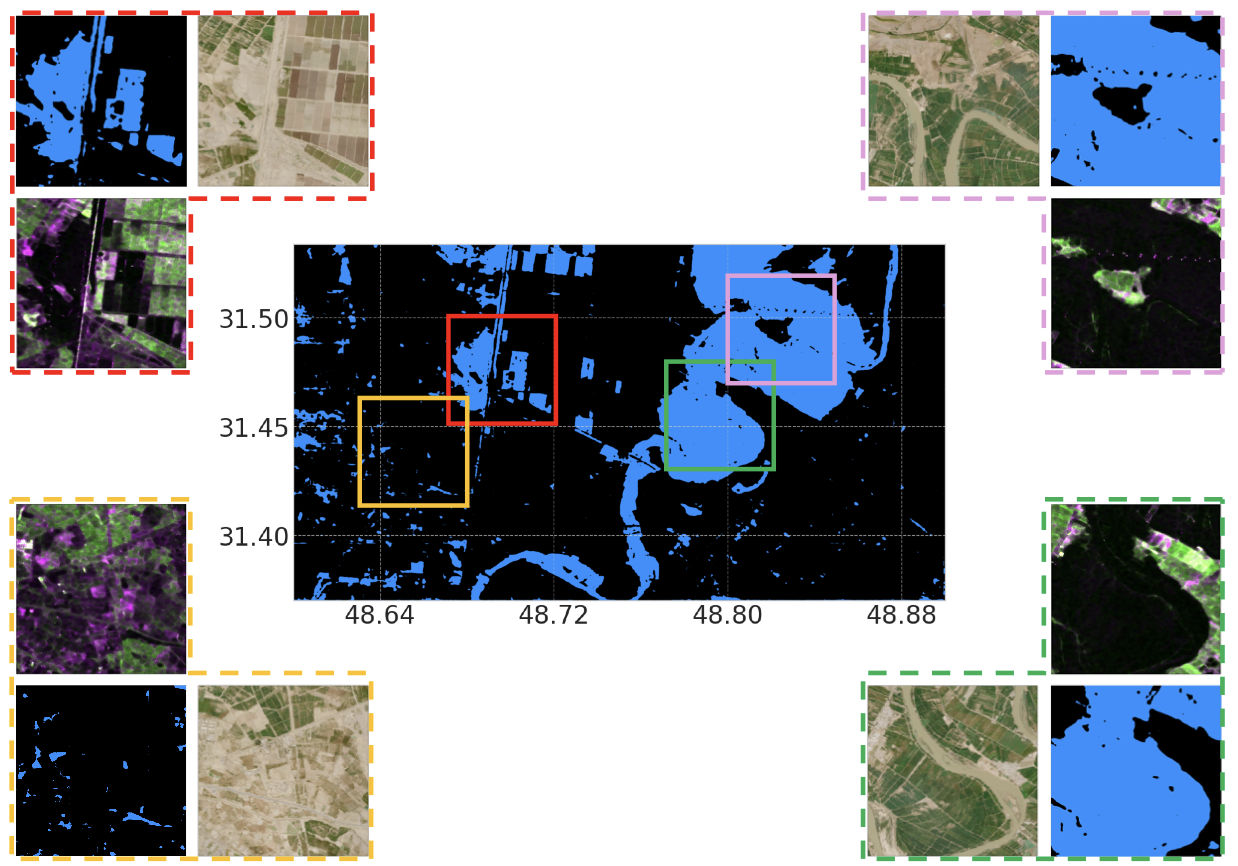
To address the limitations of cloud cover and misclassification in traditional flood mapping, this study introduces a novel hybrid framework that combines metaheuristic optimization algorithms with deep learning semantic segmentation models. By applying this methodology to Sentinel-1 SAR imagery of the 2019 Iran flood, the integration of a Swarm-based Simulated Annealing feature selection technique with a CPNet architecture achieved highly precise, high-resolution flood extent mapping.


