Publications
"What we observe is not nature itself, but nature exposed to our method of questioning"
- Werner Heisenberg
Towards Self-calibration of Rainfall Estimation through Soil Dynamics and its Signals Using Supervised and Unsupervised Machine Learning Clustering Methods over CONUS
Agricultural and Forest Meteorology
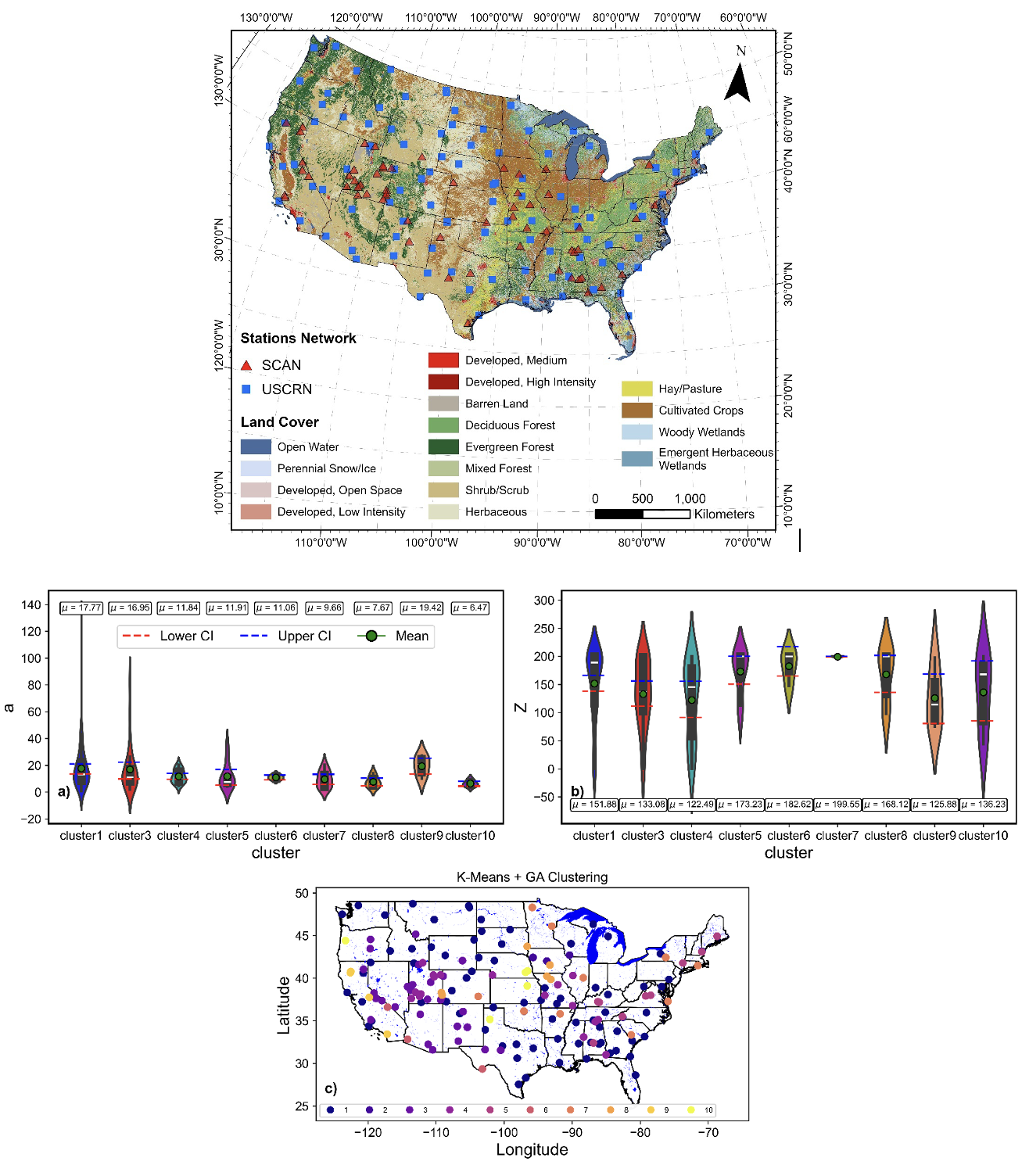
This study introduces a novel self-calibrating framework that combines supervised and unsupervised clustering with genetic algorithm optimization to enhance the SM2RAIN-NWF algorithm for accurate, calibration-free, continental-scale rainfall estimation from soil moisture dynamics across diverse environmental conditions.
Leveraging a Novel Straightforward Integration Approach for Independent CYGNSS Soil Moisture Retrieval across Vegetated Regions
Journal of Remote Sensing
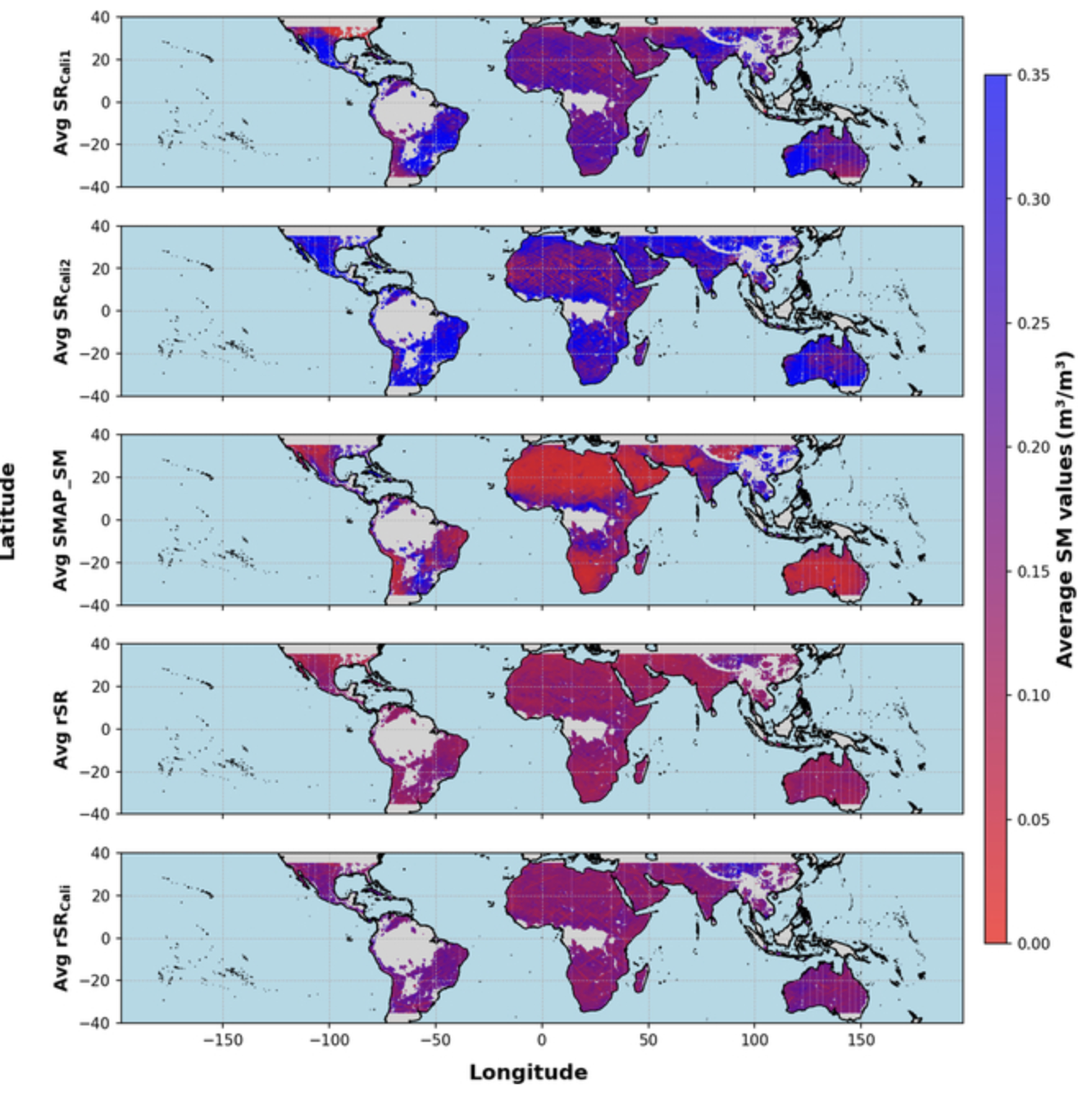
We present a simple yet effective method for retrieving near-surface soil moisture using CYGNSS data, designed to work independently across vegetated regions. By integrating CYGNSS reflectivity with ancillary land surface and vegetation datasets, we decouple vegetation effects without complex modeling. The approach shows strong agreement with in situ observations and demonstrates robust performance across varying land cover conditions.

A Novel Soil Moisture Validation Method Utilizing Brightness Temperature
GIScience & Remote Sensing
This study introduces a 1 km summer-season brightness temperature dataset and a two-step soil moisture (SM) evaluation method that combines physical modeling and machine learning. The new dataset, developed from SMAP and radiative transfer modeling, improves spatial resolution in areas with low vegetation and shows strong validation performance. The two-step method enables area-based SM validation and outperforms traditional point-based approaches, proving effective across diverse environments. Additionally, it identifies overestimations in ERA5 SM data, particularly in tropical regions, highlighting its usefulness for global SM product evaluation.

Investigating the vulnerability and resilience of different land cover types to flash drought: A case study in the Mississippi River Basin
Journal of Environmental Management
Flash droughts are fast-developing droughts that can seriously affect both nature and human activities. This study examines how different types of land, such as forests and farmland, respond to flash droughts in the Mississippi River Basin (MRB) from 2000 to 2022. Using a drought index (SAPEI) to detect drought events and plant growth data (GPP) to measure recovery time, researchers identified 315 flash droughts and analyzed the 10 most severe cases. Recovery times varied widely, from 8 to 120 days, with the longest delays occurring in extreme drought years like 2006, 2012, and 2022. Forested areas bounced back quickly, while farmland, especially rain-fed crops, took the longest to recover, showing their high vulnerability to sudden moisture loss. The Upper MRB, with drier conditions and heavy agricultural use, had the slowest recovery. These findings highlight the need for better drought management, including improved water use strategies and drought-resistant crops, to help vulnerable areas cope with future flash droughts.

Observational Analysis of Long-term Streamflow Response to Flash Drought in the Mississippi River Basin
Weather and Climate Extremes
This study looks at how sudden, intense droughts, called flash droughts, affect river flow in the Mississippi River Basin (MRB) from 1980 to 2022. Using a drought index called SAPEI, researchers identified over 1,000 flash droughts and found regional differences in how they occur. The eastern MRB has frequent but short droughts, the northwest has fewer but longer ones, and the southern MRB experiences the most severe droughts, influenced by upstream water use. A strong link was found between drought conditions and lower river flow, showing that SAPEI is a useful tool for tracking these impacts. This research helps improve water management and prepares for future droughts.

A Stand-Alone Framework for Predicting Spatiotemporal Errors in Satellite-Based Soil Moisture Using Tree-Based Models and Deep Neural Networks
GIScience & Remote Sensing
Soil moisture (SM) is a critical climate variable, and assimilating satellite SM into land surface models via land data assimilation (LDA) enhances continuous SM modeling and climate extreme monitoring. However, LDA often assumes static SM error dynamics, limiting accuracy. This study introduces a novel framework integrating triple collocation analysis (TCA) with machine learning (ML), including Light Gradient Boosting Machine (LGBM) and Deep Neural Networks (DNN), to quantify spatially and temporally continuous satellite-based SM errors globally.
Using only Soil Moisture Active Passive (SMAP) retrieval data, our TCA-based time-variant error prediction models successfully recover error information in regions where SMAP SM error data were previously unreliable. The SMAP-based model outperforms models relying on external datasets like the Global Land Data Assimilation System (GLDAS), offering a robust approach for improving LDA in data-scarce areas. This method also extends to other satellite-based geophysical datasets, broadening its applicability beyond SMAP.


