When the soil surface dries, the groundwater below follows with a delay: soon where the land is wet, late where it is dry. This study mapped that delay over the whole globe for twenty years. Where the delay is long, flash droughts are frequent, so the delay may serve as a simple sign of where and when the land is exposed to them.
At a glance
- Theme: Flash drought and groundwater
- Data: Twenty years, 2004 to 2023, of a land model that takes in satellite gravity measurements (GLDAS-2.2), in steps of five days
- Approach: The time groundwater takes to respond to the soil surface, estimated again and again through the record
- Scale: Global, on a grid of 0.25°
- Lead author: Dr. Hoang Hai Nguyen
- Status: Published, data and code open

The basics
A flash drought is a drought that sets in within weeks. The rain fails, the air is hot and dry, and the soil dries from the top down. Below the soil lies groundwater. In wet regions the water table is shallow: it receives water from the soil and gives water back, so in a dry spell it cushions the soil above it. In dry regions the water table lies deep. It is fed only from above, a shortage at the surface reaches it late, and it offers the soil no cushion.
The question
How long does groundwater take to respond to the surface? Where and when is that time long, and does it tell where flash droughts strike? Wells that record groundwater are too few and too unevenly spread to answer this for the globe.
How it was measured
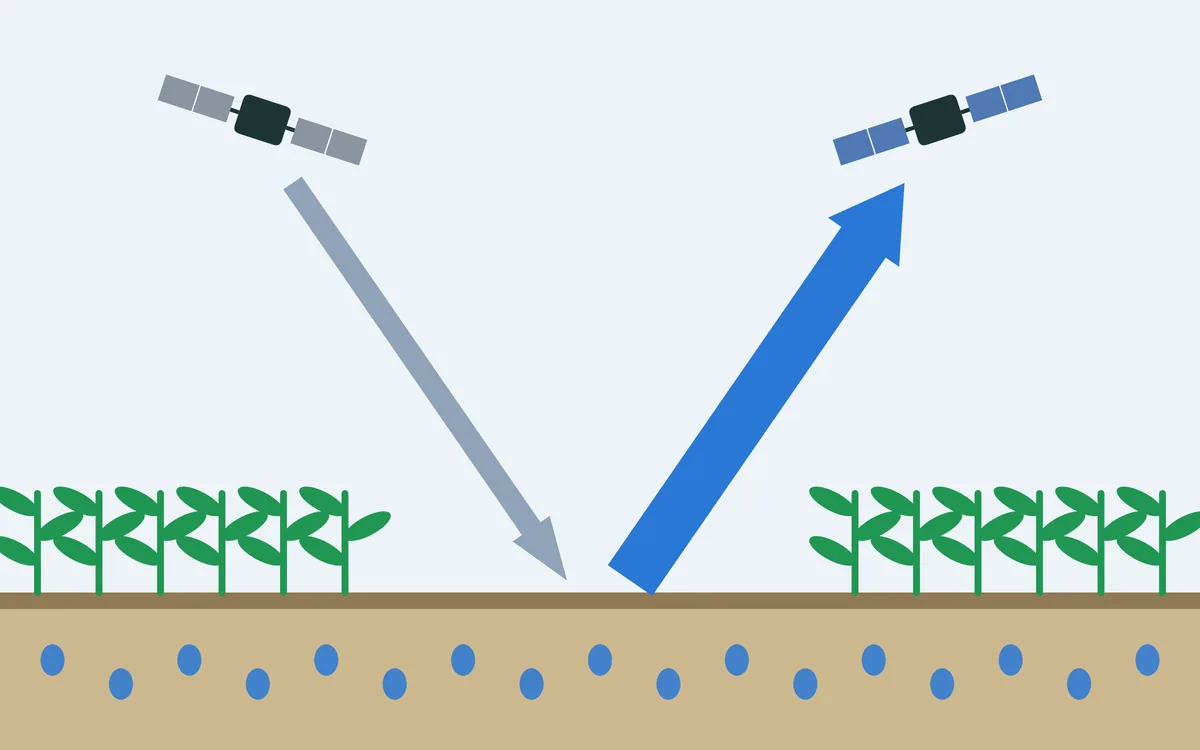
The study uses a global record of twenty years in which a model of the land surface is corrected with the measurements of the GRACE satellites, which weigh the water stored on and under the land. From it come five quantities as five-day means: the moisture of the top few centimetres of soil, the moisture of the root zone, groundwater storage, evapotranspiration and runoff.
The response time is found with a simple device. The record of surface soil moisture is smoothed with a memory of a chosen length until it resembles the record of groundwater. The length that fits best is the response time: a single number for everything that slows water on its way down. It is fitted again and again in a window of one year that moves through the record, so it can change with the seasons and from year to year.
A flash drought is counted when the moisture of the root zone falls, within at most twenty days, from above the 40th percentile for the time of year to below the 20th, and stays there for at least fifteen days.
Where the two go together

Long response times are found in the drylands. Flash droughts are most frequent in the climates between dry and wet, the semi-arid and the dry sub-humid regions. The two coincide there: on 30 per cent of semi-arid land and 33 per cent of dry sub-humid land both a long response time and flash droughts are frequent, against 17 per cent of arid land and 6 per cent of humid land. The largest such areas lie in western North America, eastern Europe, eastern South America and southern Africa.
Through the year
The link also holds from season to season, and not only in those areas. Almost everywhere, a drier root zone goes with a longer response time, and the onset of a flash drought goes with a longer one too. The link is strongest in the seasons when the soil is wet and the water table is connected to it. In the dry seasons soil and groundwater are decoupled, the response is slow, and the link weakens.
What lengthens the response

Land loses water in two ways: to the air, as evapotranspiration, and to the rivers, as runoff. The study asked how much of the link between soil surface and groundwater goes back to each. Evapotranspiration matters more. Where long response times and flash droughts are both frequent, it leaves a clear mark on 54 per cent of the land, runoff on 39 per cent. When evapotranspiration draws the soil down, less water is left to seep to the water table, the response lengthens, and the ground loses its cushion.
What the result does not say
Four cautions go with the result. The numbers come from a model that takes in satellite data, not from groundwater measured in wells; against wells in six countries the model's groundwater agreed moderately, with correlations of about 0.4 to 0.5. The link is a statistical one and no proof of cause, because the response time and flash droughts may both follow the same weather. The method assumes a shallow water table that exchanges water vertically, and it suits regions with deep water tables or strong sideways flow less well. And a window of one year cannot show response times longer than that.
Why it matters
Forecasts of flash drought draw on many variables at once. A single number with a long memory, which marks the regions and seasons where the ground has lost its cushion, is a practical addition to early warning. The work goes on in the lab's current project on flash droughts that reach groundwater.
The paper
Nguyen, H. H., Long, D., Wang, S.-Y. S., Yoon, J., Zhong, Y., and Kim, H. (2026). Dynamics of model-based groundwater-land surface response times as a dryland flash drought diagnostic. Communications Earth & Environment, 7, 852. The work was done with colleagues at Tsinghua University, Kasetsart University and China University of Geosciences (Wuhan). The article is open access.